Description:
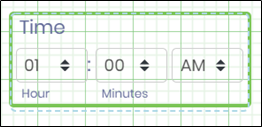
This widget renders a time selection control.
Inputs
- FormID - Name of the widget generated by FlowWright (read-only field)
- Lock Widget - Click the button to toggle the lock/unlock feature
Design:
The Time widget is registered in FlowWright under the Engine category. Its internal name is time, and its display name is Time. The widget is associated with the implementation class FlowWright.Forms.clsTime in the FlowWright.Forms.dll assembly.
Typical Workflow Suggestions:
The following five examples are potential use cases based on the widget's name and required time-zone input. They assume that the implementation supports the relevant time-related behavior.
Meeting Scheduling
Consider using the Time widget in a meeting request form where the user selects a time zone relevant to the meeting. Verify whether the widget supports displaying or handling meeting times in that zone.
Employee Shift Management
Evaluate the widget for an employee scheduling form where time zone information may be needed when recording or reviewing shift-related details.
Global Service Requests
Consider including the widget in a service request form used by teams across different regions, allowing the relevant time zone to be identified for time-related information.
Appointment Booking
Evaluate the widget for an appointment request form where the selected time zone may help interpret the requested appointment time.
Cross-Regional Workflow Coordination
Consider using the widget in a workflow form that collects time-related information from users in different regions. Confirm whether the selected time zone can be stored and used by subsequent workflow operations.
Example:
Let’s build and execute the “TimeWidgetDef” example.
- Create a new Form Definition called “TimeWidgetDef.”
- Drag a “BootstrapGrid, Label, Textbox, Time, and Submit” control onto the canvas and arrange them as shown below.

- Double-click the “Time” widget to configure its properties. A pop-up window appears for configuration. Select the time zone from the drop-down list. Check the box to hide the control at runtime. Click the “Lock Widget” button to toggle the lock/unlock feature and prevent accidental configuration changes. Click the “Save” button.

- Double-click the “Hour” drop-down widget to set the “Settings” properties. Check the “Required” checkbox to make input mandatory. Click the Preview button to see the list of items, then click the Save button.

- Double-click the “Minutes” drop-down widget to configure the “Settings” properties. Select the “Required” checkbox for mandatory input. Click the Preview button to view the list of items, then click the Save button.

- Save the Form Definition. Choose the Actions > Create Form Instance menu option. Generate a new Form Instance, then check the box to edit it.

- The Form is shown to the user as illustrated below. Select the time, then click the Submit button to finish.

Tips:
-
Configure the required input: Ensure the
timeZoneinput is supplied because the XML marks it as required.
-
Verify available time zones: Test the options provided by the
TimeZoneListdata type.
- Test different selections: Check whether changing the selected time zone affects the widget's behavior.
- Validate saved data: Confirm that the selected time zone is retained and can be retrieved after form submission.
- Test regional scenarios: If the widget supports time conversion or time display, verify behavior across relevant time zones and daylight-saving transitions.
Definition Sample:
You may download and extract the sample definition(s) from the link provided and later import them (drag-and-drop) into your FlowWright Process Definition (XML file) or Form Definition (HTML file) page.
Note: After the import, verify and complete any missing configuration steps, such as file path references and database connections. Then, save the definition to confirm the changes.
Click here to download the sample file.