Dashboard widgets are UI components used to build dashboards. This section allows the Admin user to manage dashboard widgets, preview and analyze usage patterns, export and import widgets between FlowWright environments, and enable globalization and auto-detection of new dashboard widgets.
Go to the Administration > Dashboard Widgets menu option.

The Dashboard Widgets UI is displayed as follows. The widgets are organized and shown in a table with columns for display name, description, and validation status. Use the Search box to filter the list.

Select the Dashboard Widgets menu to access the Widget Categories option.

Select the “Actions” menu to access functions like “Create, Edit, Copy, and Remove the Dashboard Widgets.

Select the “View” menu to access the “Preview, With Errors, Usage, Dashboards, and Not Used Widgets” options. Use these options to preview the dashboard, review usage statistics, and view errors.

Select the “Export” menu to access the “XML and SQL” functions. You can export dashboard widgets across FlowWright environments using this feature.

Select the “Import” menu to access the “XML” function. You can import dashboard widgets from another FlowWright environment with this feature.

Select the “Utils” menu to access the “Auto Detect, Auto Detect from DLL, Auto Detect from Directory, and Globalize” functions. Use this feature to automatically detect and add your custom dashboard DLLs and to globalize the dashboard content.

Select the “Support” menu to access the “Request Item” and “How to create” functions. Use this feature to request additional dashboard widgets from the product support team.

For the FlowWright Multi-Tenant version:
Go to Administration > Dashboard Widgets. The page will open in a new tab.
The Dashboard Widgets page is displayed with a MultiTenant menu in the Tenant Manager application, as shown below. The menu includes options to push widget configurations or updates to selected or all tenants.
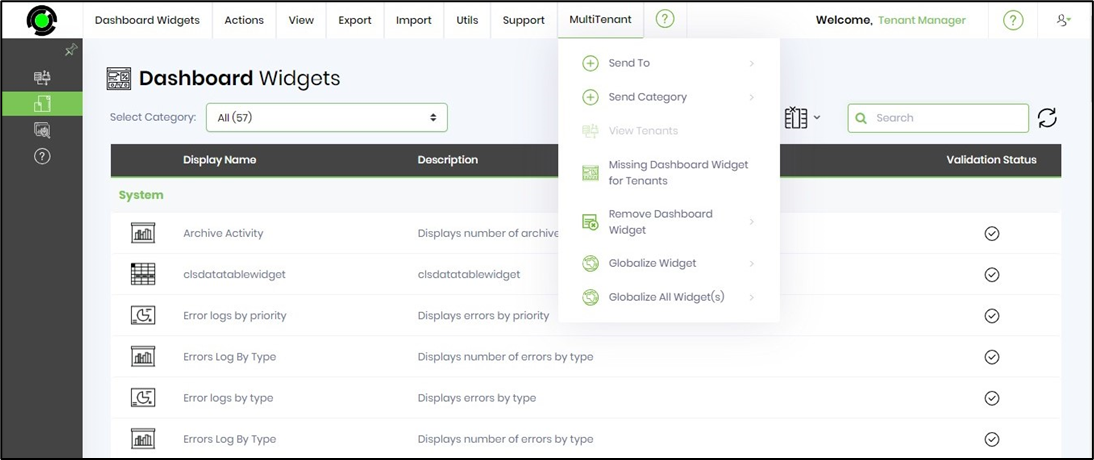
Pushing step configuration to tenants