Description:
The GetTaskComments step belongs to the Engine category in FlowWright. Its XML definition identifies the step as gettaskcomments, with the label "Get task comments" and the display name "Get Task Comments." This step retrieves task comments for later use in the workflow.
The step is defined as a Process step with two input connections and two output connections. It provides one configurable property:
- Variable/Global to hold comments – specifies the Variable/Global that stores the retrieved task comments.
The property is a required string property.
The XML definition does not expose a separate task-selection property, a result-format property, a task ID property, or any other configuration. Therefore, the supplied definition does not specify how the step determines which task's comments are retrieved. That behavior should not be inferred from the XML definition alone.
Typical uses include:
- Retrieving comments associated with a workflow task.
- Making task comments available to subsequent workflow steps.
- Using comments as input to later business logic.
- Capturing task-related comments for downstream processing.
- Evaluating or routing workflow processing based on retrieved comment information.
- Preserving task comments in a Variable/Global for later use in the workflow.
- Using retrieved comments as part of notifications, reporting, or other workflow operations.
Inputs
- varGlobalComments – specifies the Variable/Global to hold the retrieved task comments. The property is displayed in the designer as a Variable/Global to hold comments and is a required string property.
Returns
- True – Indicates that the workflow continues through the True path.
- False – Indicates that the workflow continues through the False path.
Usage:
The GetTaskComments step is typically placed in a workflow to retrieve task comments and make them available to subsequent workflow operations.
During execution:
- Configure the required Variable/Global to hold the comments property.
- Execute the step.
- The retrieved comments are made available through the configured Variable/Global.
- Continue workflow processing through the True or False path according to the operation result.
The XML definition requires the Variable/Global destination property.
A typical workflow might look like:

Typical workflow suggestions:
- Comment-based workflow processing - Retrieve task comments before a subsequent workflow operation that needs to process or evaluate them.
- Approval or review processing - Use the step after a review-oriented task when comments associated with the task need to be made available for subsequent workflow processing.
- Comment-based notification - Retrieve comments and use the resulting Variable/Global in a later notification or communication operation.
- Workflow auditing - Use retrieved comments as input to a subsequent operation that records or processes task-related information.
- Conditional processing - Retrieve task comments before a decision or conditional operation when the workflow needs to use the comment information in subsequent processing.
- Reporting or information collection - Make task comments available to later workflow operations that collect or assemble task-related information.
Example:
Let’s build and execute the “getTaskCommentsDef” example.
- Create a new process definition named “getTaskCommentsDef” and open it in designer mode.
- Drag the “Task, getTaskComments” steps to the canvas.
- Connect the dots between the “Start” and other steps, as shown above.
- Select the line between the steps to configure the “Connection Properties”. The default property values are “None, True, False, Error, and Evaluate”. Depending on the step’s purpose, additional values are available for configuration.
- Define a variable or a global variable to store the task comments.
- Click the “Task” step to configure its “Required” properties. Enter the name and task description. Click the Save button. Note: Click the "AI Predict" button to have the Copilot add new process steps that match your process description.

- Click the “Task” step to configure its “Optional” properties, then route the task to yourself or another user. In this case, the system variable “variable.initiatorID” routes the task to the user who initiated the process instance.

- Click the “getTaskComments” step to configure its “Required” properties. Provide a name for the step and a variable or global reference to store the comments.

- The “Logging” configuration is necessary for documentation and to measure workflow progress and percent complete. This is done by configuring the step state and percent fields individually, as shown below. Configure the “Logging” using the following properties.

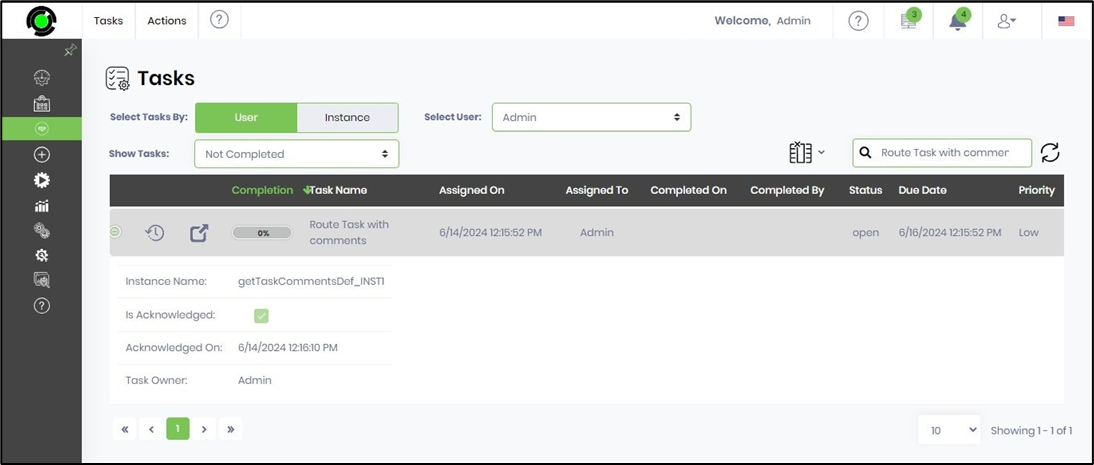
- Save the process definition, create a new instance, and execute it. The task is assigned to the configured user. Navigate to the Engage - Task page to view the task or use the task notification. Click the task row to open it.
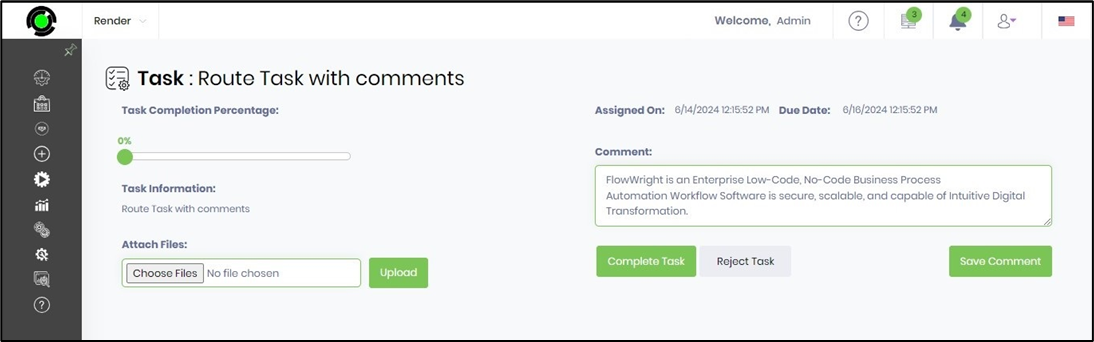
- Enter the task comments, then click the Complete Task button.
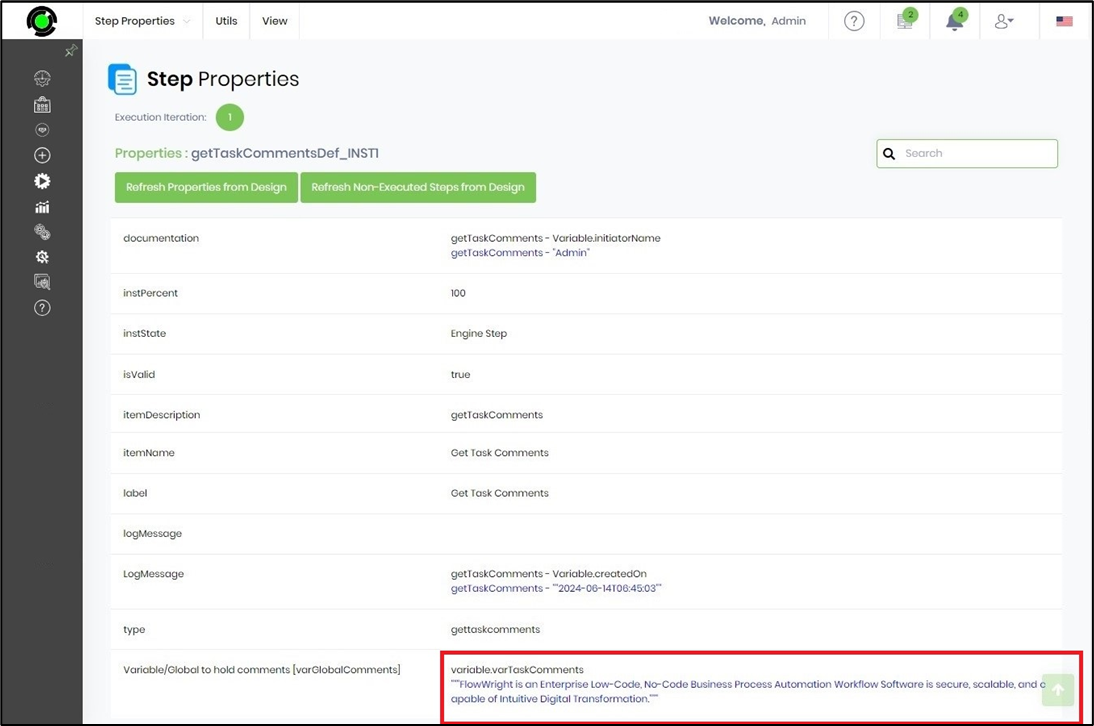
- The task is complete, and the process moves to the getTaskComments step in the workflow. The task comments are fetched and initialized into the provided variable or global reference. The process is complete.
- Navigate to the "Process Instances" page. Select the process instance and render it. Click the “getTaskComments” step to view its properties. This step retrieves the task comments.
Tips:
- Always configure Variable/Global to hold comments because it is a required property.
- Use a clearly named Variable/Global so that the purpose of the stored comment information is easy to identify.
- Place the step before the workflow operation that needs to consume the retrieved comments.
- Use the True path to continue the normal workflow when the operation succeeds.
- Use the False path for appropriate exception or alternate processing.
- Test the workflow with tasks containing representative comments before deploying it.
- When comments may be used in downstream notifications or reports, verify that the stored value contains the expected information.
- Do not assume a specific comment format, ordering, or task-selection mechanism unless it is documented separately by the FlowWright implementation.
- The supplied XML does not expose a result-format configuration, so do not assume that the step supports selectable XML/JSON output formats.
- The supplied XML does not expose a task-selection property. If the task context is determined automatically by FlowWright, that behavior should be verified against the product implementation or additional documentation.
Notes:
- Category: Engine.
-
Internal name:
gettaskcomments. - Label: Get task comments.
- Display name: Get Task Comments.
-
Namespace:
FlowWright.Workflow.GetTaskComments. -
DLL:
FlowWright.Workflow.dll. - Step definition type: Process.
- Input connections: 2.
- Output connections: 2.
- Variable/Global to hold comments: Required.
- Variable/Global to hold comments: String data type.
-
String property: Supplied by
FlowWright.DataTypes.ClsTextBox. - Execution paths: True and False.
- Task selector: Not exposed by the supplied XML.
- Result format: Not exposed by the supplied XML.
-
Result Variable/Global property: The XML exposes
varGlobalCommentsfor storing comments. - Connection-string, timeout, transaction, retry, or scheduling properties: Not exposed by the supplied XML.
- Detailed comment-retrieval behavior: Not exposed by the supplied XML.
Comparison with GetTaskFileAttachments.
The GetTaskComments and GetTaskFileAttachments steps are both Engine Process steps that retrieve information associated with a FlowWright task. However, they retrieve different types of task information.
The GetTaskComments XML exposes only the required varGlobalComments string property for storing comments.
The GetTaskFileAttachments XML exposes three properties: taskStepID for selecting the task step, resultFormat for selecting the result type, and taskFileAttachments for storing the XML/JSON representation of the task attachments. The task-step and output properties are required, while the result format is optional.
Practical distinction
Use GetTaskComments when the workflow needs comment information associated with a task.
Use GetTaskFileAttachments when the workflow needs file-attachment information associated with a task.
The two steps can be used together when a workflow needs to collect both types of task information.
Definition Sample:
You may provide a sample process definition for the GetTaskComments step and import it by drag-and-drop into the FlowWright Process Definition (XML file) page.
After importing the sample, verify and complete any environment-specific configuration, particularly:
- Variable/Global to hold comments
- Connections to the surrounding workflow steps
- True and False execution paths
- The task context required by the workflow
After verifying the configuration, save the Process Definition before executing the workflow.
Click here to download the sample file.