1. Welcome.
Welcome to the FlowWright REST API Guide. This guide describes how to set up and utilise FlowWright’s REST API.
What is a REST API?
REST APIs are hosted on a web server accessible from any platform. The platform could be a tool, a different technology, or even a completely different operating system. REST uses HTTP or HTTPS to request data from web or application servers. REST calls send a request object, and the server processes the call and returns a response object.
1.1 Installation.
The REST API is installed and configured automatically by the FlowWright installer; it is part of the FlowWright UI. In earlier versions of FlowWright, it was separate but not fully integrated. You can access the REST API using the following URL:
http://localhost:8080/api/index.html
The URL above also offers the Swagger documentation for the REST API.
API Security.
The REST API is protected by three authentication methods. You may use any of them, and they are:
- Basic
- API token
- oAuth
Basic Authentication.
When using FlowWright's authentication, provide the username and password. For other authentication methods, such as Windows or SAML, where FlowWright does not store a user password, use the FlowWright license key as the password. The license key can be found in the FlowWright UI under Status > License.

Token Authentication.
Please refer to the Token authentication document.
OAuth Authentication.
Please consult the OAuth authentication document.
REST API.
The following sections will demonstrate how to access the REST API using different methods.
Accessing the REST API Site.
The REST API offers a Swagger-based documentation site; here’s how to access it. Navigate to the following URL:
http://localhost:8080/api/index.html
The site should be displayed as follows:

As shown in the list, each call is labeled with its HTTP method (e.g., GET, DELETE, or POST) and a description. You can expand any call and test it in the UI.
- Expand the Document category to access the following REST APIs.

- Expand the Folder category to access the following REST APIs.

- Expand the ESB (Enterprise Service Bus) category to access the following REST APIs.

- Expand the ETL category to access the following REST APIs.

- Expand the Lookup category to access the following REST APIs.

- Expand the Process category to access the following REST APIs.

- Expand the Roles category to access the following REST APIs.

- Expand the Tasks category to access the following REST APIs.

- Expand the Token category to access the following REST APIs.

- Expand the Users category to access the following REST APIs.

- Expand the Utils category to access the following REST APIs.

Calling a REST API with authentication.
Let’s test a REST API call that requires authentication. Navigate to the “User/GetUser” class.

Click the “Try It Out” button to test the REST API call. Then click the “Execute” button to start. Enter the FlowWright user credentials (with REST API permissions) to Sign In.

If the authentication succeeds, the following response will be shown:

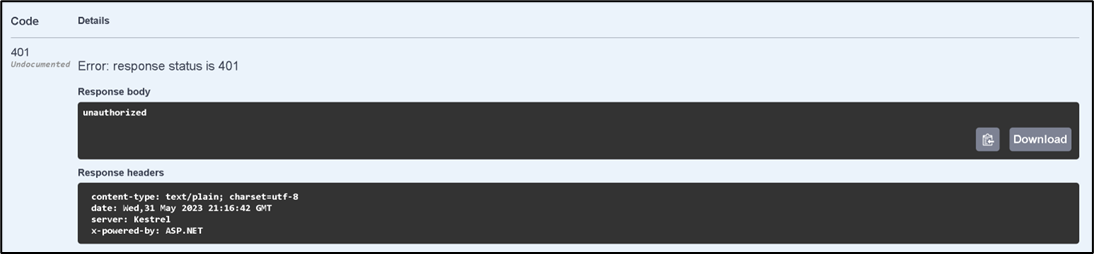
If authentication fails, you will see the following response.
More complex REST API calls.
REST API calls vary in complexity depending on the functionality. The complexity depends on the input parameters and their data structure. Here’s the REST API call to create and execute a process instance using a process definition.

Multitenant REST API.
FlowWright API is also compatible with multitenant environments.
The URL is the same as the one used for making a REST API call, but the tenant name is added to the beginning of the URL.