Description:
The Instantiate from File workflow step creates process instances from data contained in a CSV or XLS file. According to the step definition, it instantiates a process instance for every single row of the data file.
The step allows the workflow designer to:
- Specify the path to a CSV or XLS file.
- Map file columns to FlowWright Variables or Globals.
- Specify whether the first row contains column headings.
- Optionally pass Variables to each instantiated process instance.
- Optionally pass Globals to each instantiated process instance.
- Select the process definition to instantiate.
- Select an execution priority.
- Route the workflow through True or False return paths.
Inputs
- Path to a CSV or XLS file; specifies the location of the data file that contains the rows used to create process instances.
- passGlobals - Specifies whether Globals should be passed to each newly instantiated process instance.
- passVariables - Specifies whether Variables should be passed to each newly instantiated process instance.
- columnMappings - Specify how columns in the input file are mapped to FlowWright Variables or Globals for the instantiated process instances.
- firstRowHeadings - Specifies whether the first row of the input file contains column headings.
- definitionID - Specifies the FlowWright process definition that should be instantiated for each row in the input file.
- executionPriority - Specifies the execution priority for the instantiated process instances.
Returns
- True - The True return path can be connected to the next workflow activity after the file-driven instantiation operation completes successfully.
- False - The False return path can be used for error handling or an alternative workflow path when the operation does not complete successfully.
Usage:
The Instantiate from File step is typically used when a workflow needs to create multiple process instances from structured data stored in a CSV or XLS file.
Each row in the input file represents data for an individual process instance. The required Column mappings configuration determines how file columns are associated with Variables or Globals.
A typical workflow pattern is:
Prepare Data File → Instantiate from File → Process Instances Created
For example:
Receive Batch File → Validate File → Instantiate from File → Continue Batch Processing
The selected process definition is instantiated for each row in the data file.
The optional Pass Variables to instance and Pass Globals to instance settings allow the workflow designer to control whether Variables and Globals are propagated to the newly created process instances.

Typical Workflow Suggestions:
Create Processes from a Customer Data File
Use the step when each row in a CSV or XLS file represents a separate customer request that needs its own FlowWright process instance.
Example:
Receive Customer File → Validate File → Instantiate from File → Customer Processes
Map the required file columns to Variables or Globals used by the selected process definition.
Batch Process Employee Records
Use this step when a file contains multiple employee records and each record needs to initiate the same process definition.
Example:
Employee Data File → Instantiate from File → Employee Onboarding Processes
Each row can provide the data required by an individual onboarding process instance.
Create Processes from Imported Transaction Data
Use this step when external transaction data is supplied as a CSV or XLS file, and each transaction needs to be processed independently.
Example:
Import Transaction File → Validate Data → Instantiate from File → Transaction Processing
Configure column mappings so that transaction data is supplied to the instantiated process.
Launch Multiple Approval Processes from a Spreadsheet
Use this step when a spreadsheet contains multiple requests that each require an independent approval workflow.
Example:
Approval Request Spreadsheet → Instantiate from File → Approval Processes
The selected definition can be instantiated for every row, with the relevant columns mapped to the process Variables or Globals.
Start Batch Processes with Controlled Execution Priority
Use the step when multiple process instances need to be created from a file and an execution priority needs to be selected.
Example:
Batch File → Validate Data → Instantiate from File → Process Batch
Configure the Select execution priority property according to the required process execution configuration.
Example:
Let’s build and execute the “clsInstantiateFromFileDef” example.
- Create a new process definition named “clsInstantiateFromFileDef” and open it in designer mode.
- Drag a "clsInstantiateFromFile" step to the canvas.
- Connect the dots between the “Start” and "clsInstantiateFromFile" steps, as shown above.
- Select the line between the steps to configure the “Connection Properties”. The default property values are “None, True, False, Error, and Evaluate”. Depending on the step’s purpose, you can configure additional values.
- Define a few variables or globals to store the values.
- Click the "clsInstantiateFromFile" step to configure its "Required" properties. Provide a name for the step. Provide the path to the CSV or XLS file containing a few rows of items to instantiate the process the specified number of times. Click the button to complete the column mappings. Select the process definition from the drop-down list to instantiate. Click the Save button. Note: Click the "AI Predict" button for Copilot to add new process steps that match your process description.

- The Excel file content is provided here for reference.
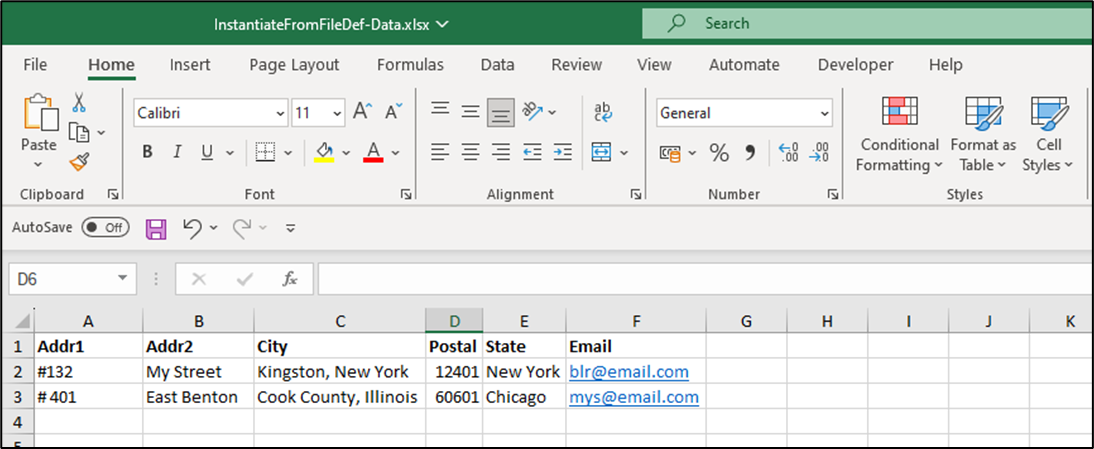
- Click the button to complete the column mappings. Provide the process variable or global reference, and specify the column position in the CSV or XLS file to be mapped. The column indexes are identified from left to right by

- Click the "clsInstantiateFromFile" step to configure its "Optional" properties. Select “Yes” to mark the first row of the file as headings. Select “Yes” if the workflow passes variables or globals to the instance. Select the execution priority from the drop-down list. Click the Save button.

- The “Logging” configuration is necessary for documentation and also measures workflow progress and percent complete. Configure the step state and percent fields individually, as shown in the images below. Configure the “Logging” using the following properties.

- Save the process definition and create a new process instance. When the workflow reaches Instantiate from File, FlowWright reads the configured CSV or XLS file and instantiates the selected process definition for each row of data. The configured column mappings determine the data supplied to each process instance. The workflow then follows the appropriate True or False return path.
Tips:
- Verify that the configured file path points to the intended CSV or XLS file.
- Ensure that Column mappings correspond to the structure of the input file.
- Confirm whether the first row contains headings and configure First row has headings accordingly.
- Select the correct process definition before executing the step.
- Verify that the Variables or Globals referenced by the column mappings are available to the selected process definition.
- Use Pass Variables to instance when you need to propagate Variables to the instantiated processes.
- Use Pass Globals to instance when Globals need to be propagated to the instantiated processes.
- Select an appropriate execution priority when the instantiated processes require controlled execution priority.
- Validate the source data before using it to create multiple process instances.
- Test the workflow with a small input file before processing a large batch.
- Verify the column-to-Variable/Global mappings carefully because the step creates a process instance for every row.
- Use the False path for appropriate error handling when the instantiation operation does not complete successfully.
- Test both True and False workflow paths before deploying the workflow.
Definition Sample:
You may create a FlowWright process definition that includes the Instantiate from File step and configure it to meet the workflow requirements.
When configuring the step, verify:
- CSV or XLS file path.
- Column mappings.
- Whether the first row contains headings.
- Whether Variables should be passed to the instantiated process.
- Whether Globals should be passed to the instantiated process.
- Selected process definition.
- Execution priority, when required.
- True workflow path.
- False workflow path.
- Environment-specific file-access configuration.
After verifying the configuration, save the process definition before executing a process instance.
Click here to download the ZIP file. The file contains InstantiateFromFileDef-Data.xlsx, FW-Fillable-PDF-Form.pdf, FW-Fillable-PDF-Form.xml and clsInstantiateFromFileDef.xml